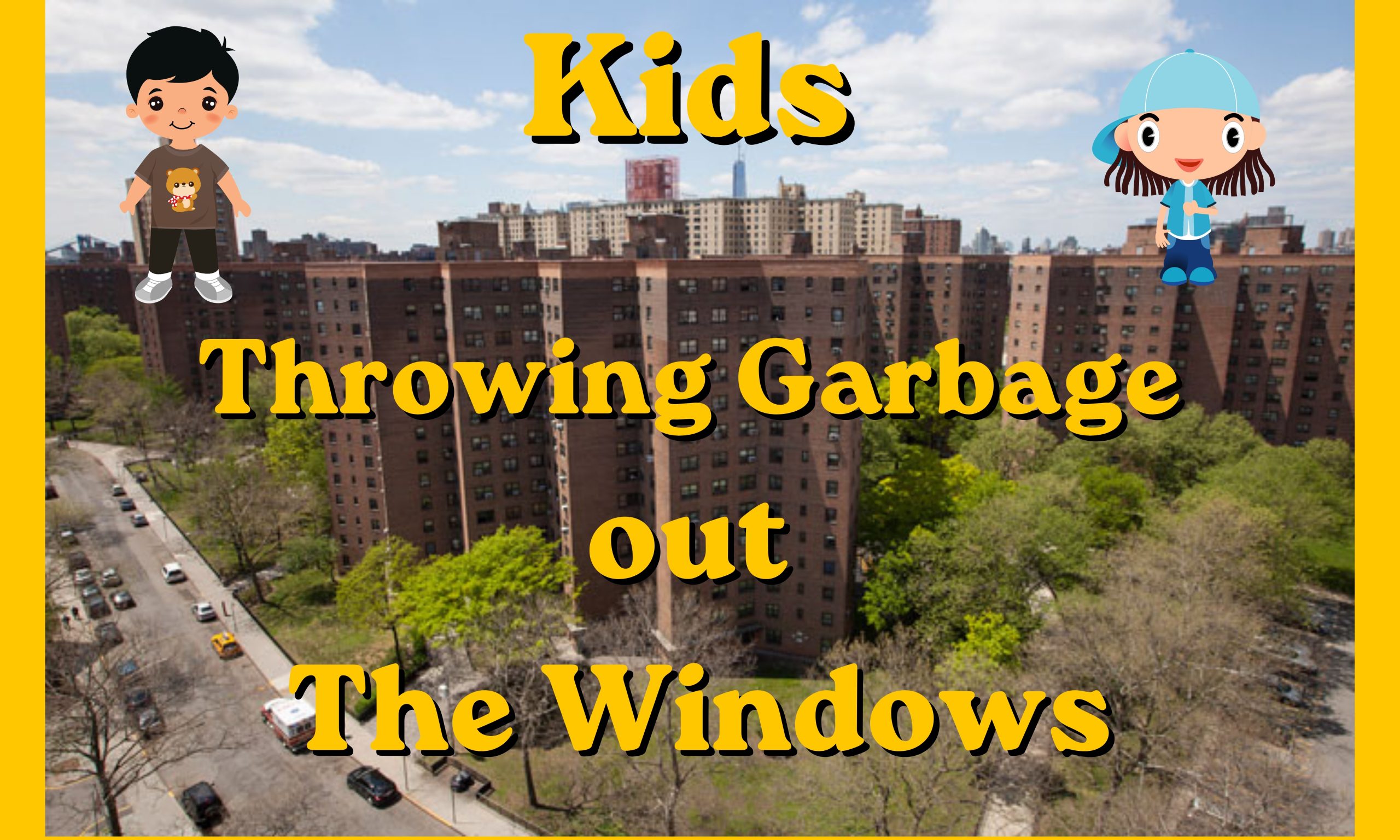
Report: Kids and Teenagers Throwing Garbage Out of NYCHA Windows
Executive summary (what this is and why it matters)
Throwing garbage (or any object) out of apartment windows is not “just littering.” It is a serious safety hazard that can injure or kill residents, visitors, and NYCHA staff below—even when the item seems small. Public health and safety guidance recognizes that objects falling from height can cause severe or fatal injuries.
It is also a clear NYCHA rule/lease issue: NYCHA guidance explicitly says trash must not be disposed of “through windows,” and it highlights that “window littering…can be dangerous (thrown objects can harm neighbors or visitors).”
Finally, it makes NYCHA grounds look and feel unlivable: improper disposal contributes to unsanitary conditions and undermines community pride.
1) Scope and context (NYCHA scale + why this shows up often in large developments)
NYCHA is extremely large: 177,565 apartments in 2,410 buildings across 335 conventional public housing and PACT developments (NYCHA’s own “Developments” page; property directory noted as of January 1, 2026).
So even if this behavior happens in a small percentage of apartments, it can still affect many courtyards, walkways, playground edges, entrances, and sidewalks across the city.
2) What’s happening (typical pattern)
In many buildings, the pattern looks like this (based on common reports and how “high-rise littering” behavior tends to operate):
- A child/teen tosses small trash (wrappers, bottles, bags, food, paper) out a window.
- It becomes a game: the “fun” is the reaction, the sound of impact, the feeling of control/power, peer attention, or simply boredom.
- It often happens when the parent/guardian is not present (or is busy/asleep), because the child assumes there will be no immediate consequence.
Whether the object is “garbage” or not, the real problem is the same: items are being dropped from height into shared space.
3) Why it’s dangerous (injury mechanics in plain language)
A. Even “light” objects can seriously injure someone
Safety authorities warn that even small objects falling from a height can cause serious or fatal injuries.
That’s because gravity accelerates objects quickly. A small item dropped from an upper floor can hit with enough force to cause head/eye injuries—especially to children, older adults, or anyone caught unaware.
B. The danger is unpredictable
Parents sometimes imagine: “It’s only trash.” But:
- Wind can blow items sideways into faces or strollers.
- Objects can strike people near entrances, benches, playgrounds, or trash areas.
- Items can hit and distract drivers, cyclists, or delivery workers.
C. It creates a “normalization” effect—and escalation risk
If throwing small items out the window becomes routine and goes uncorrected, it teaches a dangerous lesson: the window is a disposal method and dropping things is entertainment.
Even if a child starts with lightweight trash, the risk is that they (or their friends) eventually test bigger/heavier items for a bigger “reaction.” High-rise littering is widely recognized to sometimes involve larger/heavier objects that create serious danger to people below.
(You do not want to wait for the first heavy-object incident to take it seriously.)
4) It also harms the development’s appearance, sanitation, and quality of life
NYCHA’s Resident Handbook explains that proper disposal helps keep buildings safe, clean, and free of rodent and insect infestation, and it explicitly forbids disposing of trash “through windows.”
When garbage lands on grounds, it:
- Makes the area look unpresentable and disrespected
- Can attract pests and create odor
- Signals to others that “nobody cares,” which can fuel more littering and damage
5) NYCHA rules and consequences (why parents must treat this as “serious”)
NYCHA rules are clear:
- NYCHA’s Resident Handbook: Do not dispose of any trash…through windows and notes window littering is prohibited and can harm neighbors/visitors.
- “Highlights of House Rules…”: “Do not throw garbage out a window…”
- NYCHA’s updated trash disposal policy (effective November 25, 2024) states that throwing trash or heavy objects out of windows is not permitted, provides a graduated enforcement process (warnings → fines), and says three or more violations within a three-month period can lead to termination of tenancy proceedings—and that NYCHA may pursue termination without graduation if there is a serious health/safety hazard.
- NYCHA’s ACOP (policy) explains termination can be based on breach of rules and regulations and “non-desirability,” including being a danger to neighbors’ health and safety or a common law nuisance.
In short: parents/guardians should treat this as both (1) a life safety issue and (2) a housing stability issue.
6) Parent responsibility (the core point)
Parents/guardians cannot control every second of a child’s choices—but they can and should do everything reasonable to prevent window-throwing because:
- The consequences can be immediate and catastrophic (injury).
- The behavior is preventable with a layered plan (below).
- NYCHA policy makes the household responsible for complying with rules and avoiding dangerous/nuisance behavior.
This is the same principle NYC uses in other window-related safety guidance: don’t leave children alone with open, unprotected windows and keep environments safe.
(Here, the hazard is not only “falling out”—it’s also “throwing out.” The prevention mindset still applies.)
Strategy for parents: stopping kids from throwing garbage out windows when you’re not around
This is a practical, layered plan that works because it removes opportunity, increases accountability, and changes incentives.
Layer 1 — Make it physically harder (environmental controls)
Goal: Reduce access to open windows + reduce access to “throwables.”
-
Window rule: No open windows unless an adult is awake and present in the room. Post it on the wall near the window in simple language. (Consistency matters more than speeches.)
-
Keep windows closed/latched when you leave NYC health guidance is blunt: never leave a child alone in a room with open windows without proper guards; keep windows closed and prevent climbing access.
Even though that guidance focuses on falls, the same control (closed windows) also blocks window-throwing. -
Request/confirm proper window guards and/or limiting devices NYC requires window guards in many buildings with children age 10 or younger, and tenants can request them.
In NYCHA specifically, the House Rules highlight that window guards can be requested and are provided (per that document).
Guards/limiters won’t stop every small item, but they do reduce dangerous access and help prevent larger-object throwing and leaning out. -
Move “throwables” away from windows
- Keep trash bags, cans, bottles, toys, and loose objects away from window areas.
- Put a lidded trash can in the kitchen (not near windows).
- Do a 30-second “window scan” before leaving: no objects on the sill, radiator cover, or furniture next to the window.
- Remove climbing access NYC health guidance: don’t place beds/chairs near windows because children climb.
This reduces both fall risk and “launch platform” behavior.
Layer 2 — Set a clear rule with a simple consequence (no long lectures)
Goal: Make the expectation unmistakable and repeatable.
Use a short script (repeat it exactly every time):
“Nothing goes out the window. Not trash. Not toys. Not food. Not paper. If you throw anything out the window, you lose ___ for __ days and you will help clean up.”
Then follow through calmly, every time.
Why this works: Kids repeat what gets reinforced. If throwing becomes a “game,” your job is to make it a boring, expensive choice (loss of privileges) and to remove the “fun” response (no yelling chase scene, no long argument).
Layer 3 — Build accountability that works when you’re absent
Goal: Replace “no supervision” with “somebody will know.”
- Two-check routine
- Check windows before you leave.
- Check windows immediately when you return. If you see evidence (trash near sill, window open, items missing), the consequence happens that day.
- Family responsibility agreement (especially for teens) Write and sign a one-page agreement:
- “Nothing out the window.”
- “If a younger child does it, the older child must stop it and tell the parent.”
- “If it happens again, privileges change.”
Teens respond better to status + responsibility than to yelling.
- Neighbor partnership (quiet, respectful) Tell one trusted neighbor:
- “If you ever see anything coming from our window line, please let me know or contact the management office.”
This turns “no parent around” into “the community sees it.”
Layer 4 — Give kids an alternative to the “game”
Goal: Replace the thrill with something acceptable.
Good replacements:
- Allow a safe “drop game” indoors with soft objects into a bin (supervised)
- Assign a “trash captain” job: tie bags, take trash properly, wipe spills (with small rewards)
- For teens: a structured after-school routine (sports, job, program, resident association activities)
Boredom + peer attention are gasoline for these behaviors. Structure is water.
Layer 5 — Use NYCHA’s rules as backup authority (not as a threat, as reality)
Goal: Make it clear this isn’t just “mom being strict.”
Explain in one minute:
- NYCHA forbids throwing trash out windows.
- NYCHA can issue warnings/fines and escalate to termination proceedings for repeated violations.
- So this behavior risks your home, not just “getting in trouble.”
This often flips a teen’s mindset from “funny” to “not worth it.”
Layer 6 — Escalation plan for repeat behavior (what parents should do next)
If it continues after the above layers:
-
Notify management first (proactive) Tell management: “We are addressing it; please document any incidents so we can correct it immediately.”
-
Ask for a maintenance inspection of windows/latches NYCHA inspections include checking window-related items (guards/latches/balances are commonly inspected as part of safety checks).
If windows don’t latch properly, kids can open them easily. -
Bring in supportive services If the child/teen is seeking risk, attention, or acting out, the most effective “stop” can be a supportive intervention (counselor, youth program, mentoring)—not only punishment.
Bottom line
Parents should treat window-throwing as a preventable, high-consequence behavior: it threatens people’s safety, violates NYCHA rules, and damages the development’s appearance and sanitation. NYCHA guidance is explicit that trash must not be disposed of through windows and that thrown objects can harm others.
Required closing statement
If anybody has any knowledge of any residents, kids, or teenagers throwing garbage (or any objects) out of NYCHA windows, contact the Management Office immediately.