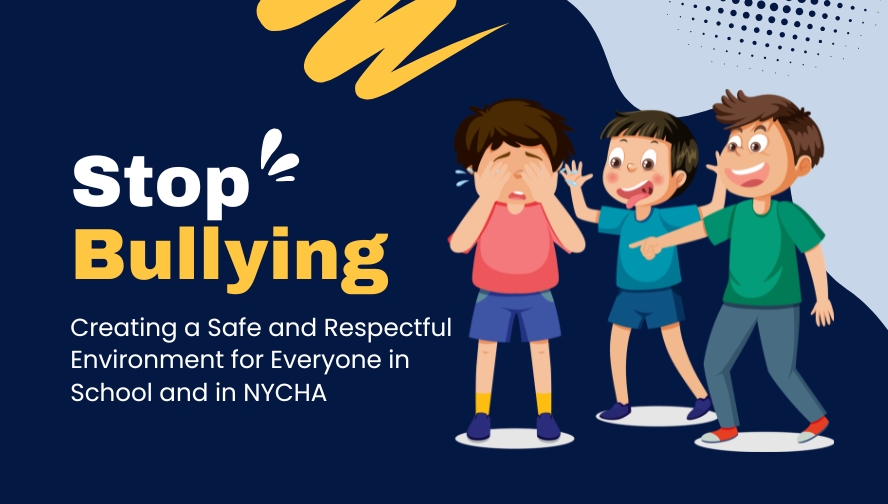
Report: The negative impact of bullying in schools, NYCHA neighborhoods, and between siblings
1) What bullying is (and why it matters)
The CDC defines bullying as unwanted aggressive behavior by another youth that involves a power imbalance and is repeated or likely to be repeated. It can be physical, verbal, relational (exclusion, humiliation), or online (cyberbullying). 1
Bullying is not only a discipline problem—it is a public health issue because it is connected with serious mental, social, and educational outcomes. 2
2) School bullying: how it damages students’ lives
A. Mental health and emotional harm
Students who are bullied are more likely to experience:
- Anxiety and depression
- Trauma-related symptoms (hypervigilance, fear, emotional dysregulation)
- Social withdrawal and shame
High-quality research has found evidence that bullying exposure in childhood contributes to later mental health problems, including anxiety and depression. 3
Also, the CDC notes that youth who are involved in bullying in different roles (bully, victim, or both) can face serious negative outcomes, and those who are both bullied and bully others (“bully-victims”) often have the most severe consequences. 1
B. School performance, attendance, and future opportunity
Bullying affects learning because kids who feel unsafe do not focus well. Common school impacts include:
- Poor attendance (avoiding hallways, lunchrooms, the bus, or specific classes)
- Lower grades and lower engagement
- Increased risk of discipline issues (sometimes a bullied student starts acting out, or a bully escalates)
The CDC summarizes that bullying is linked with poor school performance (including lower grades and poor attendance). 4
C. Social development and identity
School bullying often attacks:
- appearance, disability, weight, race/ethnicity, immigration status, gender expression, or other identities
That can shape a child’s self-concept: “Something is wrong with me,” or “I’m not safe anywhere.” Even bystanders can be affected—seeing bullying can create fear and silence, and it can normalize cruelty. 2
3) Bullying and harassment in NYCHA neighborhoods: why place matters
A. NYCHA context: bullying can blend into “street conflict”
In many high-density developments, kids’ social worlds overlap: school friends are also neighbors, and conflicts can follow a child from:
- the building lobby / courtyard → to the street → to social media → back into school
That overlap increases harm because it reduces the child’s ability to “escape” the bully. Instead of bullying being limited to a classroom, it can become a 24/7 pressure system.
NYC’s Crisis Management System and “credible messenger” approaches exist specifically because some neighborhoods experience ongoing conflict and violence—and programs focus on mediating conflicts and reducing long-term violence risk. 5
NYCHA has also highlighted that youth in public housing communities can be heavily impacted by traumatic violence and has supported violence-prevention programming aimed at safer neighborhoods. 6
B. Community violence exposure and trauma effects (relevant to neighborhood bullying)
Neighborhood bullying doesn’t always happen in isolation—it can coexist with intimidation, threats, and fights. Research on youth exposed to community violence shows links to:
- post-traumatic stress symptoms
- sleep problems and trouble concentrating
- lower academic performance
For example, studies connect violence exposure to poorer sleep and lower GPA, and also show that trauma symptoms can help explain why school functioning suffers when violence is present. 7
Clinical guidance (like the VA’s PTSD center) also describes how community violence exposure can affect children and teens and emphasizes the importance of steady, supportive adults after trauma. 8
C. The “reputation economy” and identity harm
In some neighborhoods, kids may feel pressure to avoid looking “weak.” That can push children toward:
- fighting back even when unsafe
- joining groups for protection
- carrying anger and suspicion into school
The result is a cycle: bullying → fear/shame → aggression or withdrawal → more conflict → fewer safe relationships with adults.
D. Practical life impacts for NYCHA families
Neighborhood bullying can change daily routines:
- avoiding playgrounds, courts, community centers
- not attending after-school programs
- staying inside (less exercise, less social development)
- family stress increases (arguments at home, caregiver anxiety)
So bullying becomes not only emotional harm—it becomes mobility and opportunity harm.
4) Bullying between brothers and sisters (sibling bullying): real harm, often minimized
A. Sibling bullying is not “normal rivalry”
Some sibling conflict is normal. Sibling bullying is different: it is repeated, involves power imbalance, and causes real distress or fear. A major review describes sibling bullying as persistent aggressive behavior with an imbalance of power (not just occasional arguments). 9
B. Mental health consequences can last
Research linked sibling bullying to later mental health disorders, and researchers have argued that reducing sibling bullying would likely improve longer-term mental health. 10
A key reason sibling bullying can be especially damaging is that it can happen every day at home—the place that is supposed to be safest. Some research notes this “no respite” quality as part of why it can be particularly injurious. 11
C. When kids are bullied by siblings and peers
Evidence suggests that being bullied by both siblings and peers can be linked with greater distress than peer bullying alone (in other words, harms can stack). 12
This matters because a child living with sibling bullying may arrive at school already dysregulated, anxious, or angry—making them more vulnerable to peer conflict or more likely to lash out.
5) Parents’ responsibility: stopping bullying and protecting bullied children
A. Parents must address both sides of the problem
Parents have two non-negotiable duties:
-
If your child is bullying others:
You must stop it—firmly, consistently, and with real accountability. Bullying behavior is linked to later risks like substance misuse and other problems, and allowing it to continue hurts your child’s development and harms the community. 1 -
If your child is being bullied:
You must protect them, document what’s happening, and work with the school and community supports. Bullying is associated with depression/anxiety and school harm—waiting for it to “blow over” can allow the damage to deepen. 13
B. What “responsibility” looks like in practice (clear, concrete actions)
At home
- Name the behavior plainly: “That is bullying, not joking.”
- Create a hard rule: no hitting, threats, humiliation, or harassment, including between siblings.
- Use consequences that actually matter and are consistent (loss of privileges, increased supervision).
- Require repair: apology + changed behavior + restitution (replacing broken items, helping the harmed sibling).
- Teach skills the bully often lacks: emotion regulation, conflict skills, empathy, and safe ways to gain status (sports, leadership, jobs).
With schools NYC public schools have anti-bullying structures and a complaint process under “Respect for All.” Schools define prohibited bullying/harassment behaviors (including threats, taunting, exclusion meant to isolate/humiliate, and discriminatory harassment) and provide ways to report concerns. 14
In the neighborhood (including NYCHA settings)
- Increase supervision and reduce unsupervised “hot spots” for conflict (lobbies, stairwells, courtyards).
- Build relationships with trusted adults: tenant association members, community center staff, coaches, credible messengers.
- Treat threats seriously; don’t wait for a “real incident.”
C. The moral and developmental message parents send
When adults ignore bullying (especially sibling bullying), kids learn:
- power is how you get respect
- cruelty has no cost
- victims should stay silent
When adults intervene consistently, kids learn:
- safety is a family value
- conflict has rules
- protection and accountability are real
That message can change a child’s whole trajectory.
6) What people often misunderstand (and what this report wants to correct)
-
“Bullying makes kids tougher.”
More often, it makes kids more anxious, angry, avoidant, or depressed—and it can harm school success. 4 -
“Sibling bullying is just sibling stuff.”
Persistent, power-imbalanced sibling bullying is linked with later mental health problems and deserves intervention. 10 -
“If it happens off school grounds, schools can’t do anything.”
Even when bullying originates in the neighborhood or online, it often affects school safety and learning, and schools typically have processes to respond—especially when students’ school experience is impacted. 14
Conclusion
Bullying—whether at school, around NYCHA developments, or between siblings—can shrink a child’s world: emotionally (fear, shame), academically (attendance and grades), socially (isolation), and behaviorally (aggression or withdrawal). The harm is often compounded when bullying follows a child across environments with no safe break.
Parents and caregivers are the first and most important line of defense. Their job is not only to comfort a bullied child, but also to stop bullying behavior in their own children, including at home between siblings, and to partner with schools and community resources to restore safety and dignity.